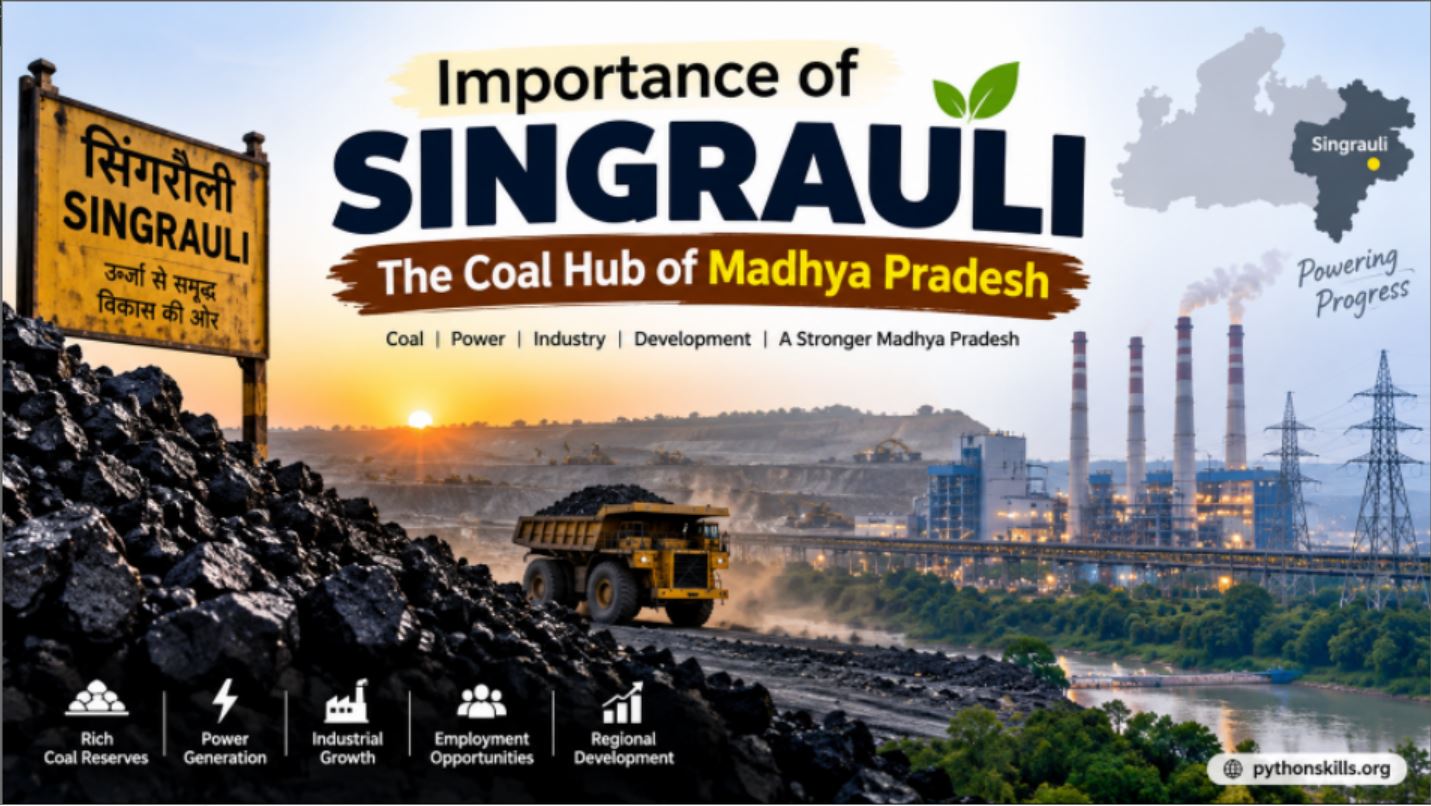
When a fan stops working on a hot summer afternoon, electricity becomes more than a convenience. It becomes a basic need. Behind that electricity is a long chain of coal mines, railway lines, power stations, workers, engineers and local communities. Singrauli, situated in the eastern part of Madhya Pradesh, is one of the most important links in this chain.
The region is often called the “Energy Capital of India” because of its rich coal reserves and large thermal power projects. However, Singrauli should not be understood only as a place where coal is dug out and burnt. It is also an important centre of employment, industrial development, infrastructure, public revenue and national energy security. At the same time, it shows the serious social and environmental costs of rapid industrialisation.
Singrauli became the 50th district of Madhya Pradesh on 24 May 2008 after being separated from Sidhi. The wider Singrauli region also includes the adjoining Sonbhadra district of Uttar Pradesh. Therefore, a proper answer must distinguish between Singrauli district in Madhya Pradesh and the larger industrial region spread across the MP-UP border. (singrauli.nic.in)
Coal Resource and Mining Base
The first and most obvious importance of Singrauli is its coal. The Singrauli Coalfield covers around 2,202 square kilometres and is divided into the Moher Sub-basin and the Singrauli Main Basin. According to the Ministry of Coal’s coal logistics document, the coalfield had estimated geological resources of about 16,411 million tonnes as of 1 April 2020, including around 8,270 million tonnes of proved resources. (coal.gov.in)
Coal mining in the region gained importance after the development of the Rihand reservoir and the growth of thermal power generation. The availability of coal and water in the same broad region made Singrauli suitable for pithead power plants. In a pithead plant, coal does not have to be transported over very long distances before being used. This reduces pressure on railway networks and improves the reliability of fuel supply.
Northern Coalfields Limited, a wholly owned subsidiary of Coal India Limited, is the main coal producer in the Singrauli area. Its mining operations are concentrated in the Moher Sub-basin through ten highly mechanised opencast mines. In 2024-25, NCL produced a record 139 million tonnes of coal. It also achieved the target of 140 million tonnes for 2025-26 on 30 March 2026, before the close of the financial year. (d3u7ubx0okog7j.cloudfront.net)
These figures explain why Singrauli is important not only for Madhya Pradesh but for the entire country. The coal produced here feeds large power stations and helps industries maintain regular production. Coal from Singrauli is therefore connected with electricity supply in distant cities, railway operations, irrigation pumps, factories and household consumption.
Major Centre of Power Generation
Coal mining alone does not make Singrauli special. Its real importance comes from the close connection between coal mines and power plants.
The Singrauli region has three major NTPC projects: Singrauli Super Thermal Power Station, Vindhyachal Super Thermal Power Project and Rihand Super Thermal Power Project. NTPC’s Singrauli plant has an installed capacity of 2,000 MW, Vindhyachal has 4,760 MW and Rihand has 3,000 MW. A useful point for examinations is that the region is inter-state in nature. Vindhyachal is located in the Madhya Pradesh part, while the NTPC Singrauli and Rihand stations are located in Sonbhadra district of Uttar Pradesh. (ntpc.co.in)
On the Madhya Pradesh side, the Sasan Ultra Mega Power Project is another major project with a capacity of 3,960 MW. It is based on six units of 660 MW each and is linked with captive coal mines. Mahan Energen in Singrauli has an operating capacity of 1,200 MW, while a 1,600 MW expansion project is under execution. (reliancepower.co.in)
The scale of these projects has made Singrauli a major base-load power centre. Thermal power can provide continuous electricity, unlike renewable sources that depend on sunlight or wind conditions. This does not mean that coal should remain the only source of energy. It means that, during the transition towards cleaner energy, regions like Singrauli continue to play an important supporting role in maintaining grid stability.
The power generated from the region is supplied to several states. NTPC states that beneficiaries of the Singrauli station include Uttar Pradesh, Rajasthan, Punjab, Haryana, Delhi, Jammu and Kashmir, Himachal Pradesh and other northern areas. Thus, the benefits of Singrauli’s power production are spread far beyond the district itself. (ntpc.co.in)
Contribution to Economy and Public Revenue
Mining and power generation have changed the economic structure of Singrauli. Earlier, many people in the region depended on agriculture, forest produce and agricultural labour. The topography and frequent droughts limited agricultural opportunities in several areas. The growth of mines, power plants and townships created a new industrial economy. (ntpc.co.in)
The economic contribution of Singrauli can be understood at three levels.
First, large companies invest heavily in mines, power stations, transmission systems, roads, railways, housing colonies and water supply. Such investment increases demand for construction material, transport, machinery, maintenance and technical services.
Second, mineral extraction contributes to government revenue through royalty, taxes and other statutory payments. The District Mineral Foundation is also important because it is meant to support people and areas affected by mining. Its focus includes drinking water, health, education, livelihood support, environmental protection and infrastructure.
Third, the income earned by workers and contractors circulates in the local economy. Shops, hotels, transport operators, repair centres, private schools, coaching institutes and small service providers all benefit from the presence of industrial establishments. The old industrial profile of the district also identified the Waidhan-Vindhya Nagar-Singrauli urban belt as a major power and industrial hub. (dcmsme.gov.in)
However, a common mistake is to assume that mineral wealth automatically leads to inclusive development. This is not always true. A district can produce huge quantities of coal and electricity while many nearby villages still face poor roads, weak health services, water problems or limited educational opportunities. Hence, the quality of local development matters as much as the quantity of coal produced.
Employment and Human Development
Singrauli creates both direct and indirect employment. Direct employment is generated in coal mines, power plants, workshops, laboratories, transport departments and administrative offices. Engineers, technicians, machine operators, safety personnel, drivers, contract workers and other support staff find opportunities here.
Indirect employment is even wider. Coal transportation, loading, equipment repair, construction, security services, food businesses, retail shops and small contractors depend on industrial activity. The development of townships has also created demand for teachers, health workers, electricians, plumbers and other service providers.
The challenge is that modern opencast mining is highly mechanised. Therefore, the output of coal may increase without creating employment in the same proportion. Local youth cannot depend only on traditional mine jobs. They need training in electrical work, heavy vehicle maintenance, welding, computer operations, environmental monitoring, solar installation and other technical fields.
The District Mineral Foundation can be used more effectively for this purpose. The Ministry of Mines has highlighted participatory planning, sustainable livelihoods and better monitoring of DMF projects. In Singrauli, DMF-supported road projects have also been presented as an example of improving connectivity between settlements and public services. (mines.gov.in)
Industrial Linkages
Singrauli’s industrial importance is not limited to coal and electricity. Power availability attracts other industries that require large quantities of energy. The wider region has mining, thermal power, chemical, aluminium, cement, sponge iron and stone-crushing activities. A CPCB report on the Singrauli area recorded the presence of several such industrial units along with coal mines and thermal power plants. (greentribunal.gov.in)
Coal ash is another area of industrial linkage. Thermal power plants generate large quantities of fly ash and bottom ash. If properly handled, ash can be used in cement, bricks, blocks, roads and mine reclamation. If it is stored carelessly, it becomes a source of air and water pollution. This is a good example of how the same industrial by-product can either support a circular economy or create an environmental burden.
Singrauli also has strategic importance for infrastructure. Roads, railway sidings, transmission lines, workshops and communication facilities have expanded because of mining and power generation. These facilities improve the movement of goods and people, though their benefits must reach rural settlements as well.
Importance for Energy Security
India’s energy demand is rising due to urbanisation, agriculture, transport, digital services and industrial expansion. In such a situation, domestic coal production reduces excessive dependence on imported fuel. NCL’s recent production performance has been directly linked by the Ministry of Coal with uninterrupted coal supply to thermal power plants and national energy security. (pib.gov.in)
Singrauli is important for energy security for four reasons:
- It has large domestic coal resources.
- It has coal mines close to major power stations.
- It supplies electricity to several states.
- It supports a wide network of mines, transport systems and power infrastructure.
The correct policy is not to ignore either energy security or environmental protection. India needs reliable electricity today, but it also needs cleaner air, water security and climate responsibility. Therefore, Singrauli should gradually move from a coal-only model towards a diversified energy and industrial model.
Major Challenges
The biggest challenge is environmental pollution. Mining produces dust from blasting, excavation, overburden removal and transportation. Thermal power plants add emissions and fly ash. The CPCB has identified particulate matter, especially PM10 and PM2.5, as important pollutants in the region. Its recent assessment described the Singrauli and Sonebhadra areas as severely polluted. (greentribunal.gov.in)
Water pollution is another serious concern. Mines require water for dust suppression and other operations, while power plants also depend on water. The region’s thermal stations draw water from the Rihand reservoir. Runoff from mine areas, ash ponds and industrial discharge can affect surface and groundwater if treatment and monitoring are weak. (ntpc.co.in)
Land acquisition and displacement have also created social tensions. Villagers may lose agricultural land, homes, common property resources and access to forests. Compensation alone cannot fully replace a traditional livelihood. Rehabilitation should include housing, land where possible, employment, education, health facilities and long-term income support. NTPC itself describes resettlement and rehabilitation of affected people as a continuing part of its work in the region. (ntpc.co.in)
There is also the problem of economic dependence. If the local economy remains heavily dependent on coal, any future decline in coal demand can create unemployment and unused infrastructure. A planned transition is necessary so that mining-affected youth are trained before mines close or production patterns change.
Way Forward
The future strategy for Singrauli should have five clear elements.
First, strict environmental monitoring is needed. Real-time emission data, air-quality stations, ash-pond safety checks and public disclosure of compliance reports should become routine. Pollution control should not remain limited to paperwork.
Second, mining companies should follow progressive mine reclamation. Overburden dumps must be stabilised, mined-out land should be restored and native vegetation should be planted. Reclaimed land can later support water bodies, forests, solar projects or community-use facilities.
Third, rehabilitation must be people-centred. Gram sabhas and affected families should be involved before land acquisition. Compensation should be timely and transparent. The social impact of displacement should be assessed not only in monetary terms but also in terms of culture, livelihood and community networks.
Fourth, DMF funds should focus on measurable outcomes. Clean drinking water, primary healthcare, respiratory disease screening, school quality, scholarships, women’s self-help groups and skill training should receive priority. Spending only on visible construction works will not solve the deeper problems.
Finally, Singrauli needs economic diversification. Solar energy, equipment repair, logistics, food processing, skill-based services and small manufacturing can reduce dependence on coal. Existing technical institutions and industrial training centres should be connected with local employers so that training leads to actual jobs.
Final Perspective
Singrauli is important because it connects natural resources with national development. Its coal supports power generation, its power supports industry, and its industrial activity supports employment and public revenue. At the same time, the region reminds us that development cannot be judged only by production figures.
The real success of Singrauli will be measured by whether its villages receive clean air, safe water, quality education and stable livelihoods along with electricity production. For UPSC and MPPSC, the best way to present Singrauli is through this balanced view: it is a coal hub, a power centre, an economic engine and also a test of sustainable development. The task ahead is not to deny its importance, but to make its growth cleaner, fairer and more secure for the people who live there.
Frequently Asked Questions
Why is Singrauli called the Energy Capital of India?
Singrauli is called the Energy Capital because it has large coal reserves, major coal mines and several high-capacity thermal power projects. The wider region supplies electricity to many states.
Is the entire Singrauli power region located in Madhya Pradesh?
No. The wider Singrauli energy region spreads across Singrauli district of Madhya Pradesh and Sonbhadra district of Uttar Pradesh. Vindhyachal is on the Madhya Pradesh side, while NTPC Singrauli and Rihand are in Uttar Pradesh. (ntpc.co.in)
What is the main challenge before Singrauli?
The main challenge is to balance coal-based economic growth with pollution control, land rehabilitation, water protection and livelihood security. Long-term diversification is also necessary because excessive dependence on coal can create future economic risks.
How can Singrauli develop sustainably?
Sustainable development will require better pollution monitoring, scientific mine reclamation, transparent rehabilitation, proper use of DMF funds, local skill development and investment in renewable energy and non-coal industries.