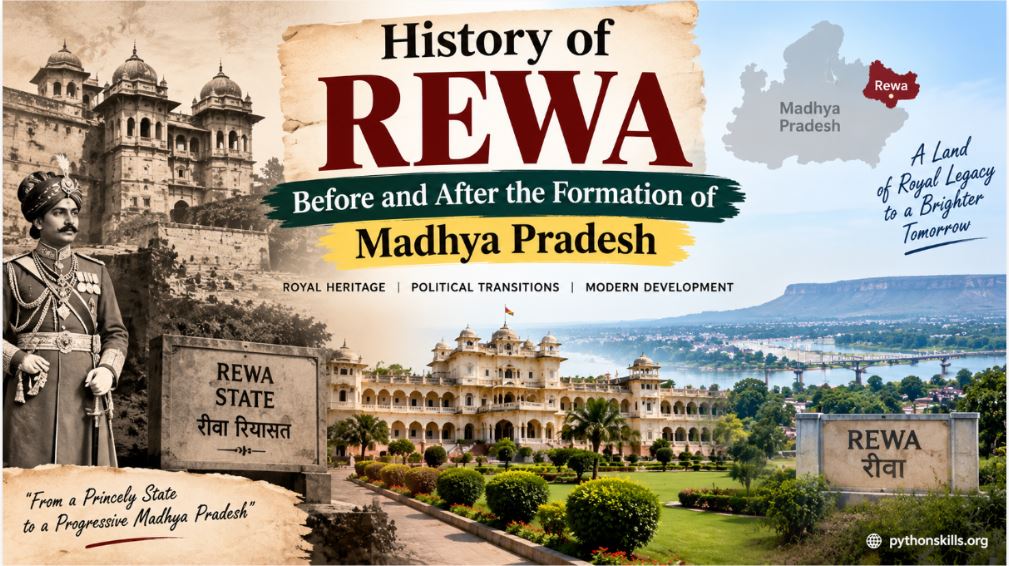
Open Google Maps and look at Rewa closely. Within a fairly small area, you will find an old fort, royal buildings, government offices, a university and busy modern roads. They belong to different periods, but together they explain what makes Rewa unusual.
This city was not always simply a district headquarters in Madhya Pradesh. It was the seat of the Baghel rulers, an important princely-state capital and, for a few years after Independence, the capital of Vindhya Pradesh.
The most interesting part of Rewa’s history is not only the rise and fall of kings. It is the way the city repeatedly adjusted to political change while keeping its regional identity alive.
First, Understand What “Rewa” Means
A common source of confusion is that the word Rewa can refer to four different things: Rewa city, the present district, the former princely state and the larger cultural region connected with Baghelkhand.
These boundaries have never been exactly the same.
The old Rewa State covered a much larger area than the present district. Rewa city served as its capital and later became the capital of Vindhya Pradesh. After the formation of the reorganised Madhya Pradesh in 1956, it continued as a district and divisional headquarters. (rewadivisionmp.nic.in)
Keeping this distinction in mind makes the full timeline much easier to follow.
Rewa’s History Began Long Before the Baghel Kings
Rewa is located in the Vindhyan landscape of north-eastern Madhya Pradesh. Its position connected northern centres such as Prayag and Banaras with routes leading towards central and southern India. This geographical advantage gave the region importance well before Rewa became a royal capital. (rewa.nic.in)
The archaeological site of Deur Kothar offers physical evidence of this older past. Located near the Rewa-Prayagraj route, the site contains Buddhist stupas associated with the Mauryan period, roughly the third to second centuries BCE. Excavations also revealed an Ashokan inscription and evidence of its connection with the wider Buddhist route between Bharhut and Sarnath. (rewa.nic.in)
In later centuries, the wider region came under dynasties and powers including the Kalachuris, Chandellas and Pratiharas. Kalachuri-period sculptures and temple remains found around Rewa still provide glimpses of the artistic traditions that existed before Baghel rule. (rewa.nic.in)
The Rise of the Baghel Dynasty
Rewa’s best-known historical identity is connected with the Baghel Rajputs. Historical accounts trace the Baghels to the Chalukya or Solanki line of Gujarat. Over time, their power moved eastwards into the Vindhyan region, where they established what became known as Baghel rule. (censusindia.gov.in)
The Rewa district administration places the establishment of the former Rewa kingdom at around 1400 AD. For a long period, however, Bandhavgarh was the main political centre of the Baghel rulers. Its hill fort offered a strong defensive position and controlled a large forested territory. (rewa.nic.in)
Rewa became more important after Mughal pressure weakened Bandhavgarh’s position.
There is a small but important difference between official accounts regarding the exact date of the capital shift. The Rewa district website mentions 1597, while the Rewa divisional history associates the expansion and establishment of Rewa as the capital with Maharaja Vikramaditya Singh in 1618. The safest understanding is that the transition happened around the end of the sixteenth and beginning of the seventeenth century, rather than through one simple overnight move. (rewadivisionmp.nic.in)
From the early seventeenth century until the end of princely rule, Rewa remained the main seat of the Baghel rulers.
A Royal Centre of Music, Literature and Architecture
The Baghel court was not limited to administration and warfare. It became known for music, Sanskrit learning, devotional writing and architecture.
Tansen’s connection with Rewa is especially important. Before becoming one of Emperor Akbar’s celebrated court musicians, he was associated with the court of Raja Ramchandra Baghel. Historical census records also describe the rulers of Rewa as patrons and writers, mentioning literary works composed by Maharajas Vishwanath Singh and Raghuraj Singh. (censusindia.gov.in)
Buildings such as Rewa Fort, Govindgarh Palace, Rani Talab and Venkat Bhawan preserve parts of this royal period. Venkat Bhawan, built during the reign of Maharaja Venkatraman Singh, now houses sculptures and objects connected with the region’s older cultural history. (mptourism.com)
This is why Rewa’s heritage cannot be understood only through a list of rulers. Music, temples, water bodies, manuscripts and palace architecture were equally important parts of court life.
Rewa State Under British Influence
Rewa did not become an ordinary British-administered district. It continued as a princely state under its own ruler, although its external relations and political position were increasingly influenced by the British.
Maharaja Jai Singh entered into an alliance with the British in 1812. Rewa later became a major state within the Baghelkhand Agency, and Rewa city also served as an important administrative centre for the agency. (censusindia.gov.in)
The events of 1857 reveal a complicated local picture. The Maharaja of Rewa assisted the British in suppressing revolts in nearby areas, but resistance also emerged within the wider region.
Freedom fighters such as Shyam Shah Singh worked with Thakur Ranmat Singh and other rebels against British forces. This means it is inaccurate to describe the whole of Rewa as either completely loyal to the British or completely rebellious. The ruler’s political position and the actions of local fighters were not the same. (amritmahotsav.nic.in)
That complexity is often missing from short versions of Rewa’s history.
From Rewa Princely State to Vindhya Pradesh
The years between 1947 and 1956 changed Rewa more dramatically than any royal succession had done.
After India became independent, the princely states had to join the new Indian Union. Rewa’s last ruling Maharaja was Martand Singh. In 1948, Rewa and several neighbouring princely states of Baghelkhand and Bundelkhand were brought together to form Vindhya Pradesh, with Rewa as its capital. Maharaja Martand Singh became the Rajpramukh, or constitutional head, of the new state. (rewadivisionmp.nic.in)
This was not simply the old Rewa kingdom under a new name. Vindhya Pradesh included dozens of former princely states with different administrative systems, local interests and political traditions.
Captain Awadhesh Pratap Singh served as the head of the government during the early period. When the Constitution of India came into effect on January 26, 1950, Vindhya Pradesh became a Part C state. It was then administered within the constitutional framework of the Indian Republic.
Following the first general elections, Pandit Shambhunath Shukla became the first elected Chief Minister of Vindhya Pradesh in 1952. (censusindia.gov.in)
For residents of that period, Rewa was therefore more than a former royal city. It was a functioning state capital with political offices, government departments and an elected assembly.
The White Tiger Story Belongs to This Period
Rewa’s famous association with the white tiger also took shape during the Vindhya Pradesh years, not during the active princely-state period as many people assume.
On May 27, 1951, Maharaja Martand Singh captured a white tiger cub in the forest area of present-day Sidhi. The tiger, later named Mohan, was brought to Govindgarh near Rewa. Its descendants eventually became known across the world, giving Rewa the popular identity of the “Land of White Tigers.” (rewa.nic.in)
The date matters because royal rule had already ended. Martand Singh retained social and cultural influence, but he was no longer ruling Rewa as an independent monarch.
What Changed on November 1, 1956?
The States Reorganisation Act reshaped India’s internal map largely on linguistic and administrative grounds.
On November 1, 1956, Vindhya Pradesh merged with Madhya Bharat, Bhopal and the relevant parts of the old Madhya Pradesh to create the reorganised state of Madhya Pradesh. Bhopal became its capital. (indiacode.nic.in)
For Rewa, the change was significant. A city that had served first as a royal capital and then as the capital of Vindhya Pradesh became a district and divisional headquarters.
However, Rewa did not become administratively unimportant. Its existing institutions and central position within the Vindhya region allowed it to remain a major centre for government services, education, healthcare and trade.
The creation of Awadhesh Pratap Singh University was an important step in this process. The university began functioning on July 20, 1968, with the aim of improving access to higher education across the Vindhya region. (apsurewa.ac.in)
Urban administration also developed gradually. Rewa’s municipal institution dates to 1950, while the city received Nagar Palik Nigam status from the Madhya Pradesh government in January 1981. (rewa.nic.in)
Rewa’s Changing Role in Modern Madhya Pradesh
Post-1956 Rewa grew as the administrative and educational centre of eastern Madhya Pradesh. Its importance came less from royal authority and more from colleges, hospitals, courts, government offices, markets and regional transport.
Administrative boundaries continued to change. In 2023, Mauganj was separated from Rewa district and became Madhya Pradesh’s 53rd district as well as the fifth district of Rewa division. (mauganj.nic.in)
The 750 MW Rewa Ultra Mega Solar Project, dedicated to the nation on July 10, 2020, gave the region a new identity in renewable energy. Part of its electricity is supplied to the Delhi Metro, connecting a largely rural area near Rewa with the daily transport needs of the national capital. (pib.gov.in)
Rewa Airport was inaugurated under the UDAN regional connectivity scheme on October 20, 2024. This marked another stage in the city’s movement from a historically important but relatively distant regional centre towards better national connectivity. (pib.gov.in)
A Simple Way to Explore Rewa’s History
Instead of seeing random monuments, follow the timeline.
- Begin with Deur Kothar to understand the region’s ancient Buddhist and trade connections.
- Visit Rewa Fort for the Baghel royal period.
- See Venkat Bhawan and its museum collection for architecture and older sculptures.
- Visit Govindgarh to connect the royal story with Mohan, the white tiger.
- Read the Census District Handbook alongside old and present-day maps to understand how Rewa’s boundaries changed.
Google Maps is useful for planning the route, but historical boundaries should always be checked through government records. A modern district map cannot explain the actual size of the old Rewa State.
Common Mistakes to Avoid
- Do not assume that Rewa went directly from princely rule to Madhya Pradesh. Vindhya Pradesh existed between the two.
- Do not treat Rewa city, Rewa district and Rewa princely state as identical areas.
- Do not place the white tiger story under active royal rule. Mohan was captured in 1951.
- Do not present 1956 as the first creation of any state called Madhya Pradesh. It was the year of the major reorganisation that created the larger state containing Rewa.
- Avoid fixing the shift from Bandhavgarh to Rewa to one unquestioned date because official accounts differ.
Why This History Still Matters
Rewa did not stop being historically important when it lost capital status. It simply acquired a different role.
Its fort recalls Baghel rule, government institutions reflect the Vindhya Pradesh period, and its university, solar project and airport represent life within Madhya Pradesh. Few cities show political transition so visibly in one place.
Understanding these layers also explains why the Vindhya identity remains strong. Rewa may no longer be a state capital, but it continues to function as the cultural and administrative centre of the region.
Frequently Asked Questions
Was Rewa ever the capital of a state?
Yes. Rewa was the capital of the former Rewa princely state and later the capital of Vindhya Pradesh from its formation in 1948 until its merger into Madhya Pradesh in 1956. (rewadivisionmp.nic.in)
When did Rewa become part of Madhya Pradesh?
Rewa became part of the reorganised Madhya Pradesh on November 1, 1956, when Vindhya Pradesh was merged into the new state. (mppcb.mp.gov.in)
Who was the last ruler of Rewa?
Maharaja Martand Singh was the last ruling Maharaja of Rewa. After princely rule ended, he served as the Rajpramukh of Vindhya Pradesh. (rewadivisionmp.nic.in)
Why is Rewa famous for white tigers?
Rewa became associated with white tigers after Maharaja Martand Singh captured Mohan, a white tiger cub, on May 27, 1951. Mohan’s descendants later reached zoological collections in different parts of the world. (rewa.nic.in)